
For chemical companies, automotive fluid brands, coating suppliers, detergent manufacturers, and industrial distributors, choosing the right plastic container manufacturer is not only about buying packaging. It is about protecting products, reducing leakage risks, improving logistics efficiency, and building a stable supply chain.
Plastic containers are widely used for liquid storage, industrial packaging, bulk transportation, and product distribution. However, different applications require different materials, structures, capacities, sealing designs, and quality standards. A container used for automotive fluids may not be suitable for certain chemical products. A container used for warehouse storage may need stronger stacking performance than one used for short-distance distribution.
That is why B2B buyers need to evaluate the manufacturer behind the container. A reliable manufacturer should understand industrial applications, material performance, molding processes, quality inspection, customization requirements, and delivery control.
As a supplier involved in plastic packaging and industrial liquid solutions, FYECO Solution supports customers with plastic packaging products, automotive chemical products, and related services. If you are sourcing plastic containers for industrial use, the following guide can help you make a safer purchasing decision.
What Does a Plastic Container Manufacturer Do?
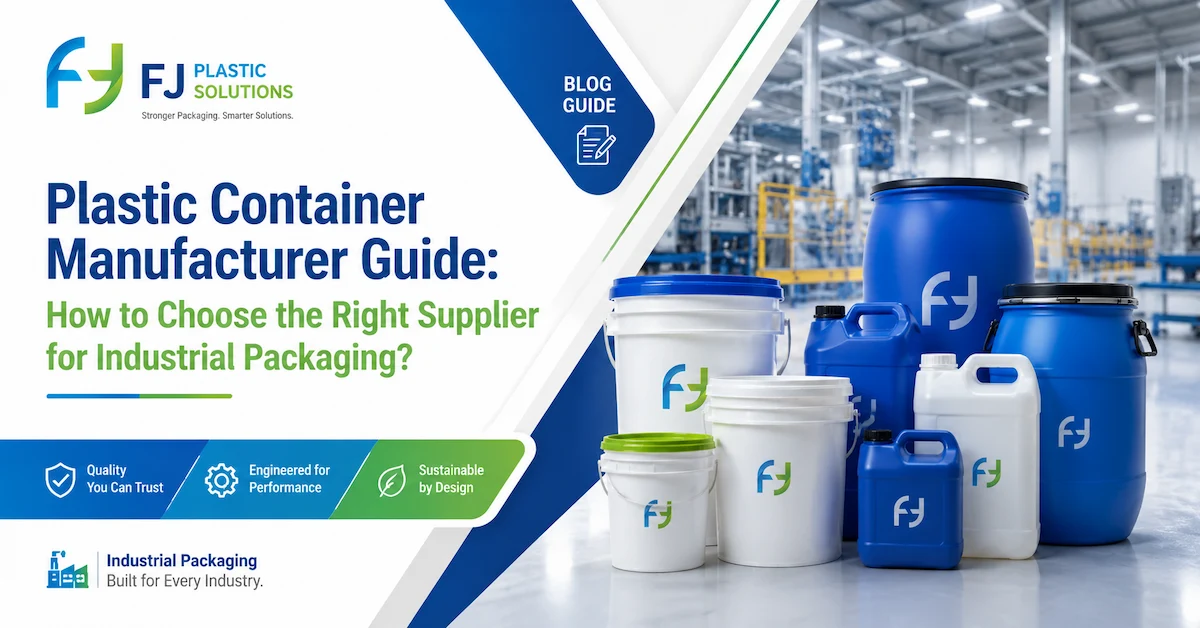
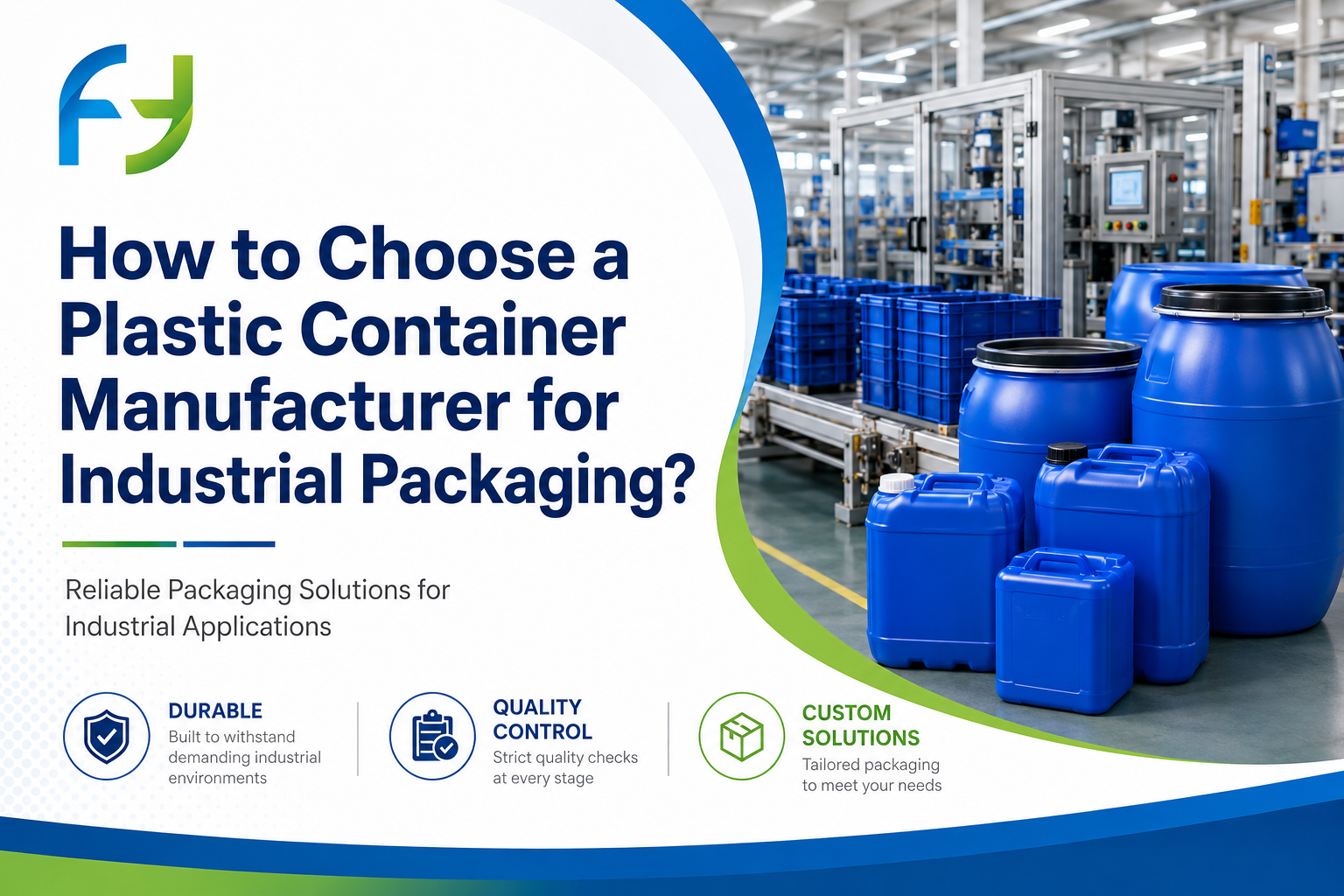
A plastic container manufacturer produces containers used for storage, filling, packaging, and transportation. These containers may include plastic barrels, drums, bottles, jerry cans, buckets, tanks, and customized packaging solutions.
For industrial buyers, the manufacturer usually needs to support more than basic production. A qualified supplier should help with:
- Material selection
- Capacity recommendation
- Container structure design
- Mold development or customization
- Sealing and closure matching
- Logo or label support
- Quality inspection
- Export packaging
- Repeat order stability
You can explore FYECO’s related product directions on the Products page.
Common Applications of Industrial Plastic Containers
Plastic containers are used in many industries because they are lightweight, cost-effective, corrosion-resistant, and easy to customize.
1. Automotive Fluids
Plastic containers are commonly used for antifreeze, coolant, windshield washer fluid, lubricants, additives, and other automotive maintenance products. These products require good sealing performance, stable material compatibility, and reliable packaging appearance.
2. Chemical Liquids
Chemical products require containers that can resist leakage, deformation, and material reaction. Buyers should always confirm compatibility between the plastic material and the liquid being filled.
3. Detergents and Cleaning Products
For detergents, cleaning liquids, and water-based products, plastic containers need stable wall thickness, easy handling, and suitable caps or lids for daily use and distribution.
4. Coatings and Industrial Additives
Coatings, additives, and industrial fluids often need strong containers with good sealing, stacking strength, and secure transportation performance.
5. Bulk Storage and Distribution
Plastic barrels and drums are often used for warehouse storage, pallet shipment, and regional distribution. In this case, stacking performance and impact resistance are especially important.
Why Plastic Containers Are Popular in Industrial Packaging
Plastic containers are widely used because they provide a practical balance between performance and cost.
Lightweight
Compared with metal containers, plastic containers are lighter and easier to handle. This can reduce labor pressure and transportation weight.
Corrosion Resistance
Plastic containers are suitable for many liquid products because they do not rust like metal packaging. This is useful for water-based products, cleaning liquids, and many automotive chemicals.
Flexible Customization
Plastic containers can be customized by capacity, color, shape, lid design, label, and packaging method. This is helpful for OEM brands, distributors, and private label projects.
Cost-Effective Production
For large-volume liquid products, plastic containers usually offer good cost control while maintaining practical durability.
Suitable for Branding
Plastic containers can support labels, printed information, color matching, and product line consistency. This helps improve shelf appearance and brand recognition.
Key Materials Used by Plastic Container Manufacturers
A professional plastic container manufacturer should recommend materials according to the application. The most common materials include HDPE, PP, and other modified plastic materials.
HDPE
HDPE is widely used for industrial plastic containers because it has good toughness, impact resistance, and chemical resistance. It is commonly used for barrels, drums, bottles, and liquid packaging containers.
PP
PP offers good stiffness and heat resistance for certain applications. It can be used when the product requires a more rigid structure or specific chemical compatibility.
Recycled Plastic Materials
Recycled materials may be used in some non-critical packaging applications to reduce cost and support sustainability. However, buyers should be careful when using recycled materials for chemical or high-value liquid packaging.
Modified Plastic Materials
Modified plastic materials can improve specific performance, such as strength, flexibility, UV resistance, or processing stability. The right material depends on the filled product and use environment.
How to Evaluate a Plastic Container Manufacturer
Choosing a supplier should not only depend on the catalog or price list. Buyers should evaluate the manufacturer from production, quality, customization, and service perspectives.
1. Material Selection Capability
Material selection is the foundation of container performance. A reliable plastic container manufacturer should understand how different materials perform under different conditions.
Buyers should ask:
- What material is used for the container?
- Is the material suitable for my liquid product?
- Can the material resist deformation during storage?
- Is recycled material used?
- Can the supplier recommend alternatives based on cost and performance?
For industrial packaging, material compatibility should always be confirmed before mass production.
2. Production Process and Equipment
The production process affects container strength, appearance, sealing accuracy, and dimensional stability. Depending on the product type, plastic containers may be produced through blow molding, injection molding, or other manufacturing processes.
A qualified manufacturer should have stable production equipment and process control. This helps reduce defects such as:
- Uneven wall thickness
- Flash or rough edges
- Weak corners
- Poor cap fitting
- Surface defects
- Deformation after filling
- Inconsistent batch quality
FYECO’s company background and industrial direction can be reviewed through the About Us page.
3. Sealing and Closure Performance
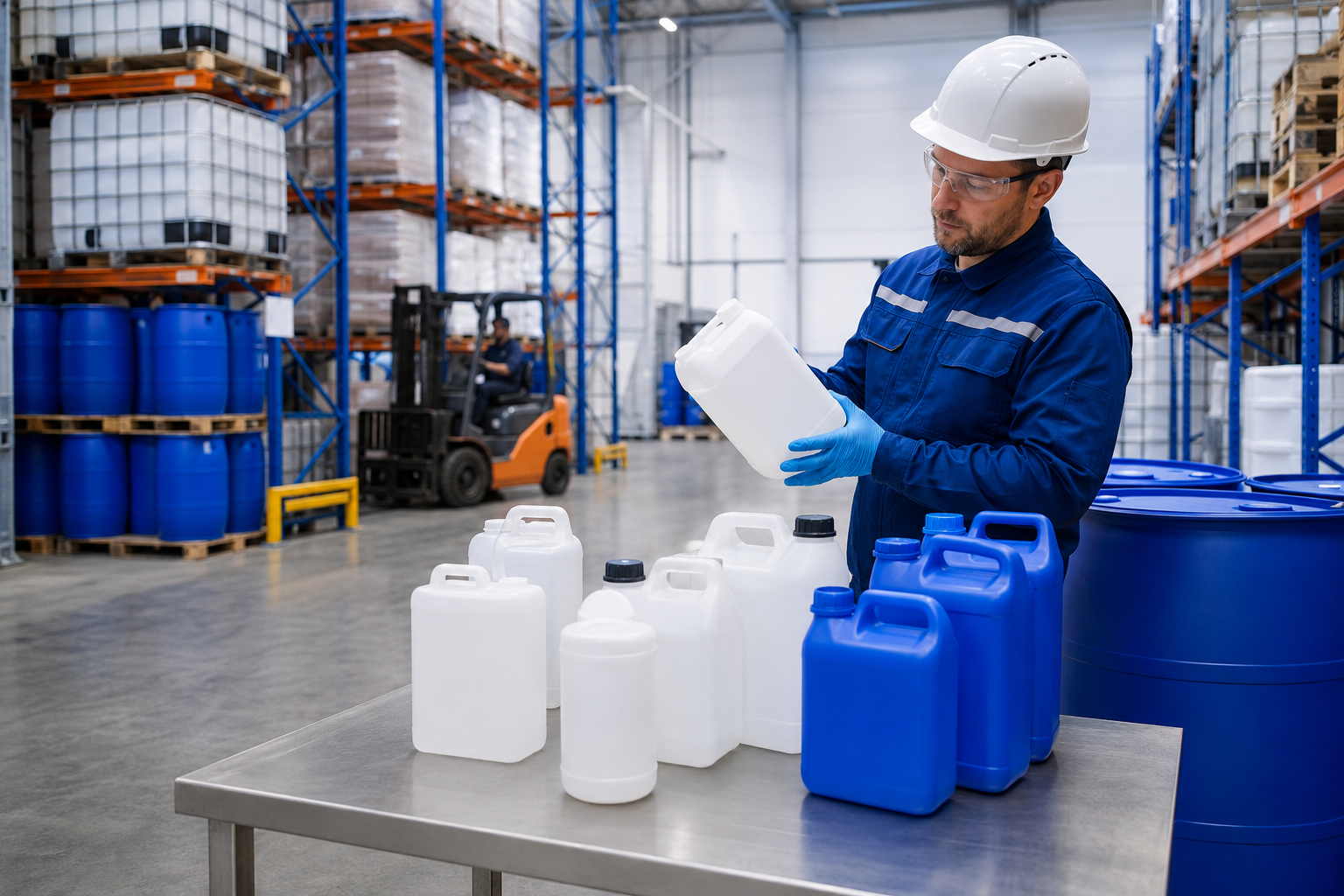
For liquid packaging, sealing is one of the most important factors. Even a strong container body can fail if the cap, lid, gasket, or opening design is not reliable.
Buyers should evaluate:
- Cap tightness
- Lid fitting accuracy
- Gasket performance
- Leak-proof structure
- Opening size
- Filling line compatibility
- Transport sealing stability
Before bulk ordering, sample testing is recommended, especially for products shipped over long distances or exported in containers.
4. Customization Support
Many B2B buyers need customized plastic containers for their own products and brands. A manufacturer with OEM and ODM capability can help buyers develop packaging that fits both product requirements and market positioning.
Common customization options include:
- Custom capacity
- Custom color
- Logo or label support
- Different cap or lid design
- Private label packaging
- Mold development
- Pallet packing solution
- Matching containers for product series
If you need custom packaging support, FYECO’s Services page can help you understand available service directions.
5. Quality Control System
Quality control should cover the full process from raw material inspection to finished product shipment. For industrial buyers, consistent quality is more important than one good sample.
A practical plastic container quality control checklist includes:
| QC Item | Why It Matters |
|---|---|
| Raw Material Inspection | Ensures stable performance and compatibility |
| Wall Thickness Check | Reduces weak points and deformation |
| Capacity Inspection | Ensures filling accuracy |
| Dimension Inspection | Supports filling line and packing consistency |
| Cap and Lid Test | Reduces leakage risk |
| Drop Test | Checks handling resistance |
| Stacking Test | Supports warehouse and pallet storage |
| Appearance Inspection | Protects brand image |
| Packaging Check | Reduces damage during shipping |
A professional manufacturer should have clear inspection standards and batch control.
6. Production Capacity and Delivery Reliability
For B2B buyers, delivery stability is critical. A late packaging shipment can delay filling, production, distribution, and customer delivery.
Before choosing a plastic container manufacturer, buyers should confirm:
- Monthly production capacity
- Standard lead time
- Custom order lead time
- Repeat order stability
- Raw material supply stability
- Emergency order support
- Export packing ability
- Container loading experience
A supplier with stable production planning can help buyers reduce inventory pressure and improve delivery control.
Plastic Container Manufacturer Comparison Table
| Supplier Type | Advantages | Risks | Best For |
| Trading Company | Easy communication, flexible sourcing | Less control over production and quality | Small trial orders |
| General Plastic Factory | Basic plastic container production | May lack industrial application knowledge | Simple packaging needs |
| Professional Plastic Container Manufacturer | Better process control, stable production, quality inspection | Requires clear specifications | Industrial packaging buyers |
| Integrated Industrial Packaging Supplier | Product application support + packaging knowledge | Requires deeper communication | OEM brands and long-term cooperation |
For buyers in chemicals, automotive fluids, detergents, and industrial products, a supplier with application understanding is usually more valuable than a supplier that only offers low prices.
Typical Plastic Container Specification Reference
| Item | Common Option |
| Product Type | Plastic container, plastic barrel, plastic drum, plastic bottle |
| Material | HDPE, PP, modified plastic materials |
| Capacity | Customized according to product needs |
| Color | Blue, white, black, natural, transparent, custom color |
| Closure | Screw cap, sealed lid, gasket lid, snap lid, custom closure |
| Application | Chemicals, automotive fluids, detergents, coatings, industrial liquids |
| Customization | Capacity, color, logo, label, cap, mold, packing |
| Packing Method | Pallet packing, carton packing, export container loading |
| Buyer Type | Manufacturers, distributors, private label brands, industrial suppliers |
Questions to Ask Before Choosing a Plastic Container Manufacturer
Before placing an order, buyers should ask the following questions:
- What materials do you use for the plastic containers?
- Can the container be used for my liquid product?
- What production process do you use?
- Can you provide samples for testing?
- Can you customize color, logo, capacity, or cap design?
- What quality inspections do you perform?
- What is your normal lead time?
- Can you support repeat orders?
- How do you pack the containers for shipment?
- Can you support OEM or private label projects?
These questions help buyers identify whether a supplier can support long-term cooperation.
Common Mistakes Buyers Should Avoid
Mistake 1: Only Comparing Price
Low price may come with thin walls, unstable material, poor sealing, or weak quality control. For industrial liquid packaging, this can create hidden costs.
Mistake 2: Ignoring Application Requirements
A container should match the filled product, storage condition, and transport method. One container design cannot fit every application.
Mistake 3: Skipping Sample Testing
Samples help verify capacity, strength, cap fitting, sealing, appearance, and handling experience.
Mistake 4: Not Confirming Packaging Method
Export packing, pallet loading, and container loading affect transportation safety and cost.
Mistake 5: Choosing a Supplier Without Stable Capacity
For long-term buyers, stable repeat orders are more important than a single low-cost purchase.
Why FYECO Supports Industrial Plastic Packaging Buyers
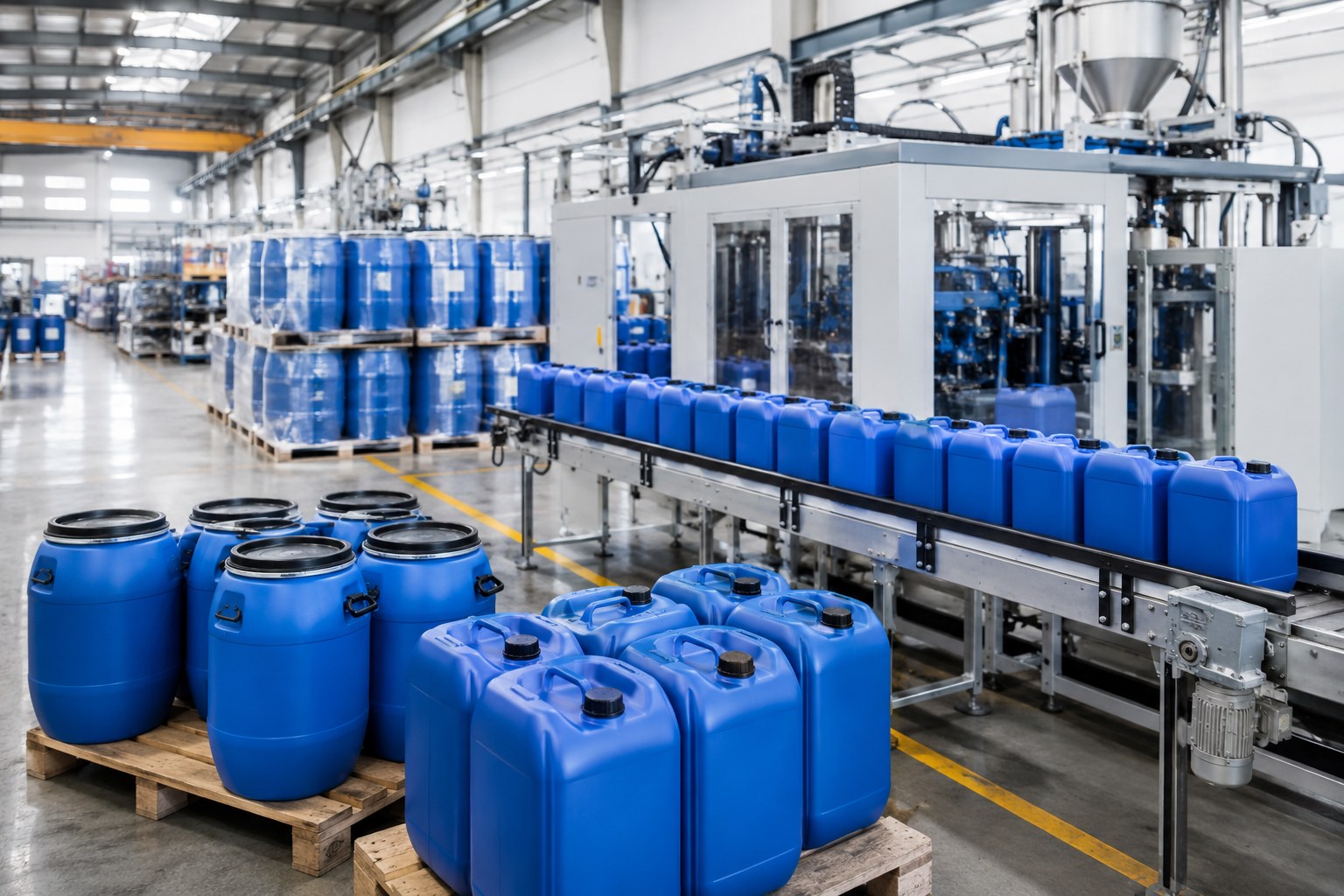
FYECO Solution focuses on industrial products, automotive chemical solutions, plastic packaging, and related services. For buyers looking for plastic containers, plastic barrels, or customized packaging, FYECO can provide application-based product communication and packaging support.
The value of choosing a supplier like FYECO is not only the container itself. It is also about understanding how the packaging will be used, filled, stored, transported, and delivered to the final customer.
To review product directions, visit FYECO Products.
To learn about service support, visit FYECO Services.
To understand the company background, visit About FYECO.
FAQ
1. What does a plastic container manufacturer produce?
A plastic container manufacturer produces plastic bottles, barrels, drums, buckets, cans, tanks, and customized packaging containers for industrial and commercial use.
2. What materials are commonly used for plastic containers?
Common materials include HDPE, PP, and modified plastic materials. The right material depends on the filled product and application.
3. How do I choose a plastic container manufacturer?
You should evaluate material quality, production process, quality control, customization ability, delivery stability, and supplier experience.
4. Can plastic containers be customized?
Yes. Plastic containers can often be customized by size, capacity, color, logo, label, cap design, and packing method.
5. Are plastic containers suitable for chemicals?
Many plastic containers are suitable for chemical packaging, but compatibility must be confirmed based on the specific chemical product.
6. What causes plastic containers to leak?
Leakage can be caused by poor cap fitting, weak sealing, uneven opening structure, material deformation, or transport damage.
7. Can plastic containers be used for automotive fluids?
Yes. Plastic containers are widely used for antifreeze, coolant, windshield washer fluid, lubricants, additives, and other automotive fluids.
8. Should I test samples before bulk ordering?
Yes. Sample testing helps verify material, capacity, sealing, strength, appearance, and filling compatibility.
9. What affects plastic container cost?
Cost is affected by material, capacity, mold complexity, wall thickness, cap design, customization, order quantity, and shipping method.
10. Where can I source plastic containers for industrial use?
You can visit FYECO Solution or review the Products page to explore plastic packaging and industrial product solutions.
Conclusion
Choosing the right plastic container manufacturer is essential for safe, stable, and cost-effective industrial packaging. Buyers should evaluate material selection, production process, sealing performance, quality control, customization ability, delivery reliability, and supplier experience.
A good plastic container manufacturer does more than produce containers. It helps buyers reduce leakage risk, protect product quality, improve logistics efficiency, and build a reliable long-term packaging supply chain.
If you are sourcing plastic containers for chemicals, automotive fluids, detergents, coatings, or other industrial liquids, FYECO Solution can help you explore suitable packaging options and customized service support.