
In industrial environments, cooling systems receive almost no rest. Equipment runs continuously for hours, sometimes even days, without needing to be shut down. Heat gradually accumulates, contaminants build up, and the chemical reactions within the coolant never truly cease.
In this situation, even a coolant that performs well at startup will begin to lose stability. Temperatures gradually rise. Deposits begin to form inside the heat exchanger. Corrosion appears in previously unaffected areas.
This model is not unfamiliar to plant engineers, maintenance teams, and coolant suppliers, and it is often costly.
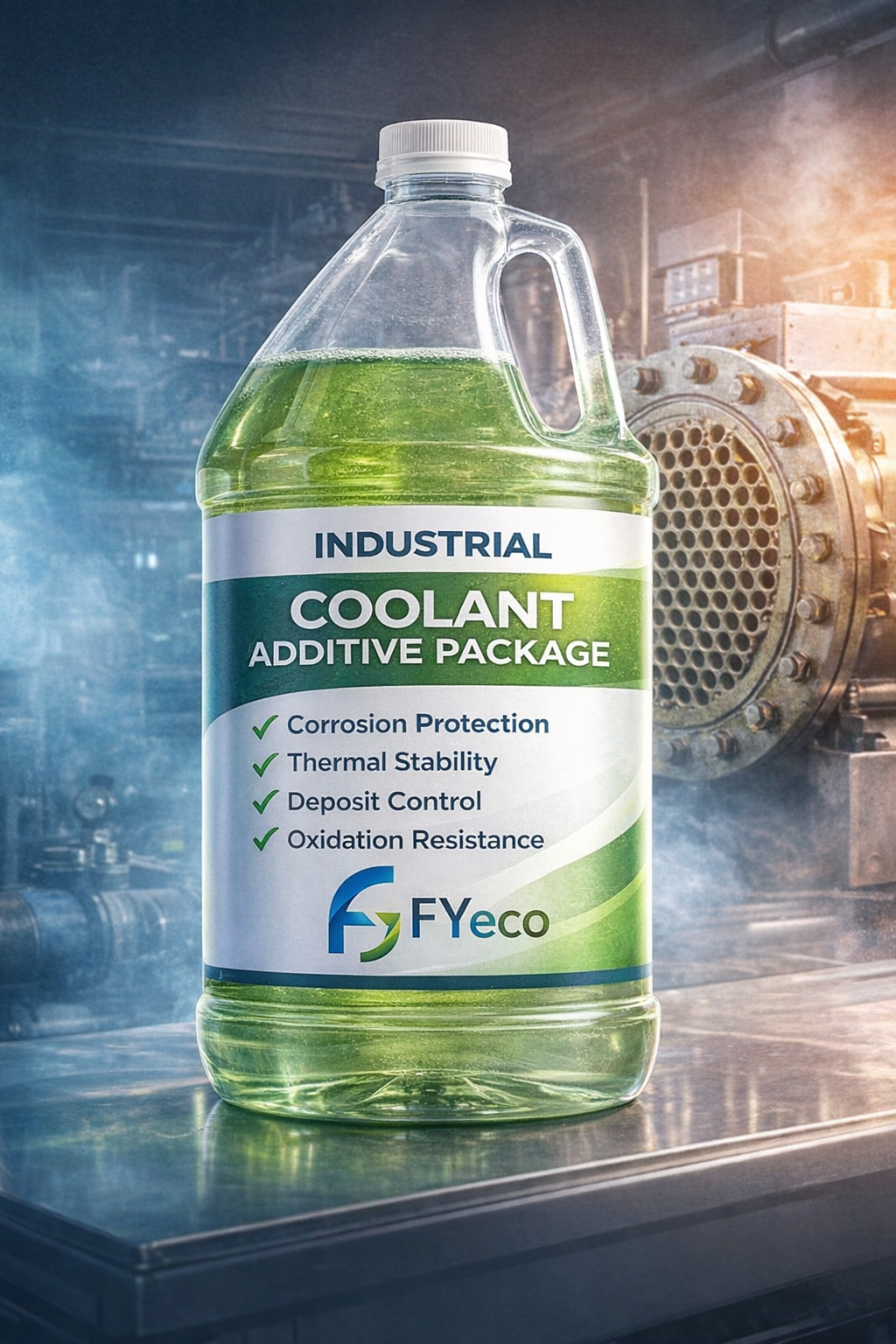
The problem isn't with the base coolant itself. More often, the additive system struggles to cope with sustained operating pressures. This is where industrial coolant additive packages become crucial. They aren't designed for short-term performance, but rather to maintain the coolant's chemical stability over long-term operation.
FYeco's additive systems developed for industrial applications have only one objective: to maintain the stability of the coolant after initial conditions change.
Why do industrial cooling systems age faster than expected?
Unlike automotive systems, industrial cooling circuits face different stress conditions.
The temperature remains elevated for a longer period. Fluid turnover slows down. External contaminants (such as dust, metal particles, or process residues) can more easily enter the system.
These factors accelerate three key processes:
- Oxidation of coolant components
- Consumption of corrosion inhibitors
- Deposits accumulate on heat transfer surfaces
Over time, even small imbalances can be amplified. A slight increase in acidity can accelerate corrosion. Even small amounts of deposits can reduce heat transfer efficiency.
Therefore, industrial coolant additive packages must not only provide protection but also control the rate of degradation.
Core functions of industrial coolant additive systems
The industrial additive manufacturing package is designed to handle multiple stress factors simultaneously.
Corrosion inhibition remains a primary function, especially in mixed metal systems such as steel, copper, and aluminum.
In addition, sediment control has become more important. Industrial environments often introduce particulate matter pollution, which can accumulate on surfaces if not properly managed.
pH stability also plays a crucial role. Continuous operation often alters the chemical composition of the coolant over time, and buffering systems help maintain balance.
A well-designed industrial coolant additive formulation balances these functions, thus preventing any single failure mode from becoming dominant.
Performance Comparison: Standard Additive Manufacturing Software Package vs. Industrial Additive Manufacturing Software Package
| Performance parameters | Standard coolant additives | Industrial coolant additive package |
|---|---|---|
| Corrosion rate (ASTM standard) | 0.12–0.25 mm/year | ≤0.05–0.08 mm/year (↓50–65%) |
| Maintaining heat transfer efficiency | 80-88% | 92-95% |
| Sediment formation | Surface coverage 20-30% | Less than 10% |
| Antioxidant properties | Baseline | Stability is improved by 35%–50%. |
| Additive consumption rate | rapid | Reduced by approximately 40-55% |
| Maintenance cycle | shorter | Extend |
These differences are particularly noticeable in long-running operations, as small inefficiencies accumulate over time.
How does the industrial environment affect additive design?
Industrial cooling systems come in a wide variety of types depending on their application scenarios.
Fine particles are often introduced into the coolant during the manufacturing process. Additives must be able to prevent these particles from settling and forming an insulating layer.
Heavy equipment generates heat continuously under high loads. In this case, oxidation resistance becomes more important than the initial level of protection.
On the other hand, although closed-loop systems may be less susceptible to contamination, they still require long-term chemical stability.
In each case, industrial coolant additive formulations must be tailored to the specific environment, rather than relying on generic formulations.
B2B considerations: Reliability is more important than specifications.
For industrial buyers, performance data alone is not enough; long-term stability is the decisive factor.
Cooling systems are typically critical infrastructure. Unexpected failures can disrupt the entire production line. Therefore, buyers will prioritize the following:
- Long-term chemical stability
- Stable batch quality
- Compatibility with existing systems
- System monitoring technical support
Therefore, the evaluation of reliable industrial coolant additives should not only consider their initial performance, but also their predictability in long-term use.
Real-world signs of additive system breakdown
Cooling system instability rarely occurs suddenly.
Operators may notice a gradual increase in temperature during operation. The heat exchanger may require more frequent cleaning. Maintenance intervals may shorten for no apparent reason.
These signs usually indicate that the additives are depleted or out of balance, rather than mechanical failure.
Solving these problems usually requires checking the additive system itself, not just replacing the coolant.
Frequently Asked Questions
Q: Can industrial coolant additives extend system life?
Yes. A stable additive system can reduce corrosion and deposits, thus helping to extend equipment life.
Q: Are industrial additive packages compatible with all systems?
Compatibility depends on system materials and operating conditions.
Q: How often should industrial cooling systems be monitored?
Monitoring frequency depends on the load and level of contamination, but regular checks are recommended.
The stability of industrial cooling systems begins with the right additive strategy.
Industrial cooling systems operate under continuous pressure—including thermal, chemical, and operational pressures. Maintaining system stability requires more than just a basic coolant formulation.
Explore industrial coolant solutions
If you are evaluating coolant performance for industrial systems, reviewing available additive solutions can help you find formulations designed for long-term stability. You can learn about FYeco's coolant products here:
https://www.fyecosolution.com/products
Discuss your application requirements
For systems operating under continuous load, in polluted environments, or with extended maintenance intervals, discussing your specific situation will help determine a more stable additive regimen. You can contact FYeco through the following methods:
https://www.fyecosolution.com/contact-us