
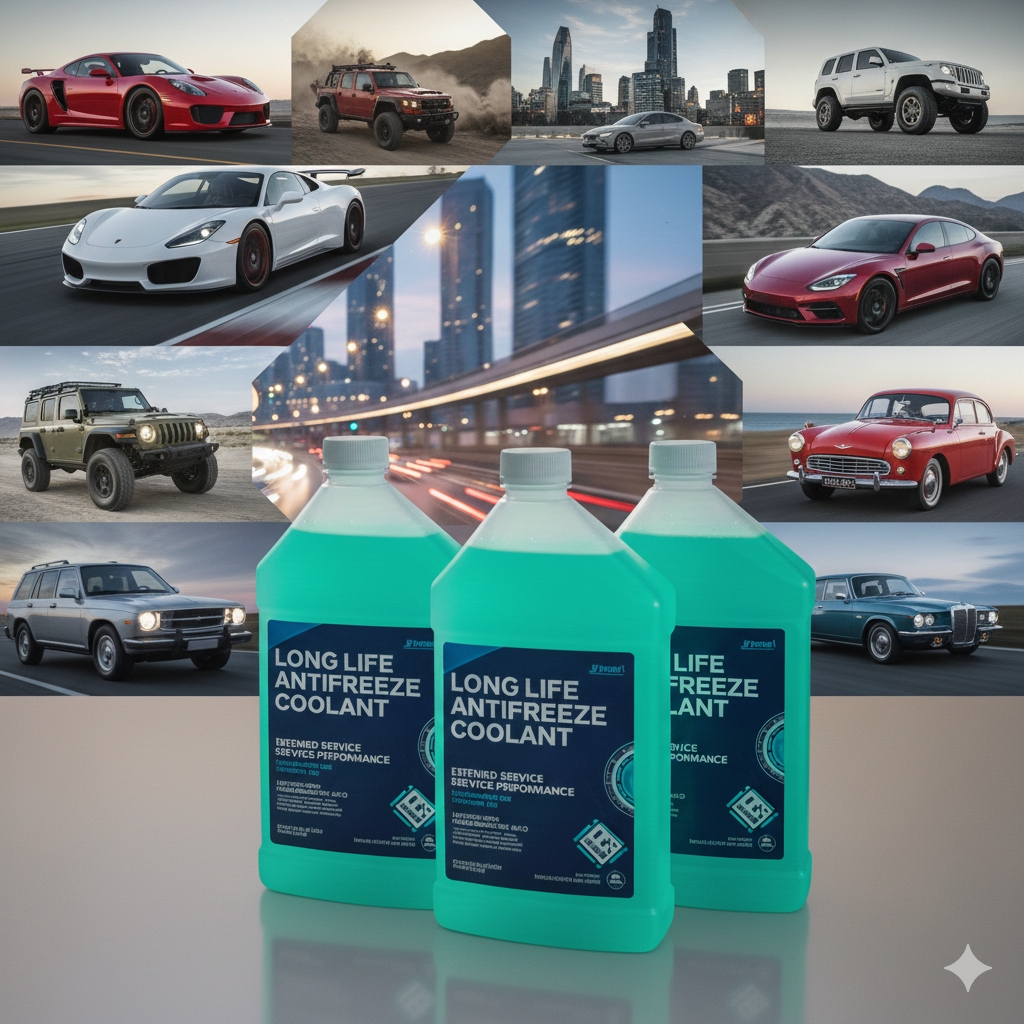
Long Life Antifreeze Coolant: Achieving Extended Service Performance in Real Engine Systems
In real automotive and industrial engines, extended coolant service performance is not determined by labels, nominal drain intervals, or marketing claims. It is determined by whether the coolant can remain chemically stable while the engine continues to operate under real thermal, mechanical, and environmental stress.
Long Life Antifreeze Coolant is typically specified in systems where unplanned downtime is costly, maintenance windows are limited, or engine reliability must be predictable over long operating cycles. However, long service life is not a default outcome. It is the result of a formulation that degrades slowly and predictably rather than abruptly or unevenly.
Understanding how this extended performance is achieved requires looking inside the coolant itself and examining how formulation design interacts with real engine behavior over time.
How Formulation Design Enables Extended Service Life
Extended service performance is engineered at the formulation level, not added later through maintenance planning.
Unlike short-interval coolants that prioritize strong initial corrosion protection, long-service formulations are designed to control the rate at which protection is consumed. This approach ensures that corrosion inhibitors, buffers, and stabilizing additives do not deplete rapidly during early operation, leaving the system vulnerable later.
In practical terms, this means inhibitors are selected for slow surface reaction kinetics. Rather than aggressively reacting with metal surfaces, they form protective films gradually, allowing protection to be sustained across thousands of operating hours. At the same time, buffer systems are sized to absorb continuous chemical drift caused by heat, oxidation, and minor contamination.
If either of these elements is undersized, the coolant may appear stable early in its service life but deteriorate rapidly once buffer capacity collapses or inhibitors are depleted.
Additive Architecture and Long-Term Chemical Balance
From a product standpoint, long service life depends far more on additive architecture than on base fluid choice alone.
A stable long-term formulation integrates multiple chemical functions into a single system:
-
Corrosion inhibitors compatible with aluminum, steel, copper, and solder
-
Buffer systems capable of maintaining pH stability under prolonged exposure
-
Deposit control additives that prevent fouling of heat-transfer surfaces
-
Foam suppression components that preserve circulation efficiency in high-flow systems
Two coolants with similar base fluids and identical freeze points may behave very differently after extended operation because their additive systems deplete at different rates. This divergence often explains why some cooling systems remain clean and stable after years of use, while others show corrosion residue or scaling within a much shorter timeframe.
What Happens Inside Coolant During Extended Operation
To understand why long service performance fails in some systems, it helps to follow what happens inside the coolant as it ages.
As the coolant circulates, inhibitors continuously interact with metal surfaces to maintain protective layers. Heat and oxygen gradually generate acidic by-products, which are neutralized by buffer components. Small amounts of contamination enter the system through hoses, seals, or makeup water. Thermal cycling repeatedly stresses chemical equilibrium.
In well-designed formulations, these changes occur slowly and remain balanced. In poorly matched systems, chemical drift accelerates, leading to pH instability, deposit formation, or increased corrosion activity. These internal changes often remain invisible until system performance begins to decline.
This is why extended service capability cannot be evaluated solely at installation—it must be assessed based on how chemistry evolves under real operating conditions.
Operating Conditions That Shape Real-World Service Life
Extended service life is always conditional on operating reality.
| Operating Condition | Influence on Coolant Stability |
|---|---|
| Continuous high thermal load | Accelerates additive consumption |
| Frequent start-stop cycles | Increases chemical stress |
| Mixed-metal engine architecture | Requires balanced inhibitor chemistry |
| Variable water quality | Affects buffer performance |
| Contamination exposure | Shortens effective service window |
Ignoring these factors is one of the most common reasons extended service targets are not achieved in practice.
Matching Extended Service Formulations to Vehicle and Engine Use
Long service formulations must be matched to how the engine is actually used, not just to its displacement or coolant volume.
Passenger vehicles typically operate within controlled temperature ranges, where long-term corrosion protection and aluminum compatibility are primary concerns. Commercial fleets face extended operating hours and fluctuating load, requiring greater inhibitor reserve and thermal stability. Heavy-duty and off-road equipment experiences uneven cooling and contamination exposure, making deposit control and chemical robustness critical. Industrial and stationary engines often run continuously, placing the highest demand on long-term chemical balance.
Long Life Antifreeze Coolant delivers value only when its formulation strategy aligns with these usage profiles rather than being treated as a universal upgrade.
Extended Service vs Standard Coolants in Real Operation
| Performance Aspect | Standard Coolant | Extended Service Formulation |
|---|---|---|
| Inhibitor depletion | Rapid | Gradual |
| pH stability duration | Short-term | Sustained |
| Deposit formation | Moderate | Controlled |
| Maintenance planning | Reactive | Predictable |
| Suitability for long intervals | Limited | Designed |
The practical benefit lies in predictability and reduced intervention, not in eliminating maintenance entirely.
Q&A
Q: Does higher antifreeze concentration extend service life?
No. Concentration affects freeze protection but does not improve chemical stability.
Q: Can one extended service formulation be used in all engines?
No. Material mix and operating behavior determine suitability.
Q: Does extended service eliminate monitoring?
No. Longer intervals require disciplined monitoring, not less.
Applying Extended Service Solutions in Real Engine Systems
Extended service performance is achieved only when formulation stability matches real operating conditions rather than assumptions.
FYeco develops antifreeze and additive systems designed to support predictable long-term performance across automotive and industrial engines. Reviewing suitable options within FYeco’s product portfolio allows engineers and buyers to evaluate whether Long Life Antifreeze Coolant is appropriate for their specific applications.
https://www.fyecosolution.com/products
For engines operating under continuous load, mixed-metal conditions, or strict maintenance targets, discussing system details with the FYeco team helps ensure coolant selection follows a clear, application-driven process rather than trial and error.
https://www.fyecosolution.com/contact-us